One of the most common terms to determine the possible performance for a runner is VO2 Max. It’s one of those numbers, just like FTP in cycling, that tends to be a badge of honor for some and kind of an obsession for others.
All VO2 Max means is how much oxygen your body can use every minute in relation to your weight, and is used to determine a runner’s potential in a race by coaches all around the world.
However, VO2 Max is just a number which determines how much power a person can produce but it doesn’t really tell you how efficiently he or she is using it. An athlete can have the biggest gas tank in town but waste more energy than anyone around and not necessarily win a race or maybe fall into injury more often because of overuse with bad technique.
Running economy is a better predictor of an athlete’s performance because it determines how much of the available energy will be used doing proper work. Think about it this way, when running a 10k who do you think would do better? Athlete 1 has a VO2 Max of 75ml/mi/kg and will complete the race doing forward jumping squats and athlete 2 with a modest 40ml/mi/kg will do it at a medium jog. Athlete 1 will certainly spend more energy and probably not finish the race, while athlete 2 will not do a record-breaking time but will finish and beat athlete 1.
This was an exaggerated example, but it makes a point. Records are broken by a combination of God-given talents and technique which ensures these talents are used to their maximum potential.
So, what determines running economy? It is a complex combination variable and invariable factors so to make it simple and not getting a lot in the nitty gritty for this one I made this chart: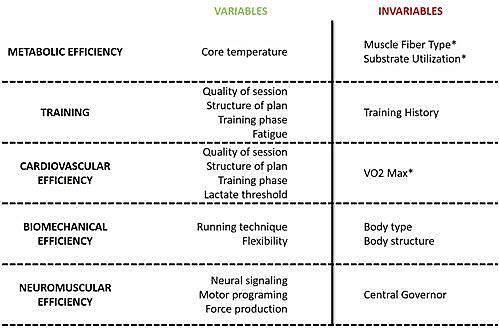
There are several of these with an asterisk because there is some wiggle room there. For example, while the proportion of muscle fibers is set at birth a person can still train type 2A fibers to act more like fast or slow twitch through training. A person’s VO2 Max has an absolute roof, but it takes lots of training and reaching optimal weight to reach it. And substrate utilization depends on factors such as diet, exercise intensity, etc.
As you can see, there are several factors which will influence how much a runner can get from his or her maximal capacity, but the good news is that outside of some genetic predispositions such as limb length, body type, and true VO2 Max there is a lot of space to work with before a runner (or any athlete, really) decides they’re done with their journey. This is why Olympic athletes keep training, there will always be a tiny bit which can be corrected or improved and will deliver noticeable rewards. My POSE method master coach Willy Heiser loves this argument for teaching technique, no one in any sport has ever achieved consistently perfect technique throughout any performance.
The reason why running economy is often overlooked or ignored is because it is extremely difficult to measure. With so many variables to calculate (I didn’t even include some external ones like clothing and weather), most coaches will focus on moving the needle on VO2 Max or Lactate Threshold. However, several studies have proven that runners who start a weight training program with really heavy weights or a plyometrics program have shown significant improvement in performance with no noticeable change in either VO2 Max or LTH, the theory is that this is through more efficient neural paths and also through a better movement through muscles which can resist more effort for longer.
Running economy becomes more relevant as distances increase because after 10km no runner will be running at their VO2 Max or LTH, but rather submaximal intensities which will require a better use of the force being used. Two athletes can have the same VO2 Max, but the more efficient one will win every time.
There are several low hanging fruits for the grand majority of recreational and serious runners which are often overlooked. See if any of these ring a bell and start doing something about it:
1. Lose (fat) weight.
It will not only increase your VO2 Max (less kilos for the same amount of available O), it will also allow for more movement and less oxygen needed to keep you alive. Other advantages are a lower core temperature, better metabolism, and increased range of motion.
2. Do strength work with heavy resistance.
Studies published in Scandinavian Journal of Medicine and Science in Sports and Medicine and Science in Sports and Exercise showed that athletes doing 3-5 reps with weights ≥85% of their one rep max improved efficiency and gained strength without gaining weight.
3. Include a plyometric workout.
Another method of gaining strength is through speed gained in plyometric exercises such as box jumps, single leg hops, squat jumps, etc.
4. Work on your running technique.
I’ve talked about this extensively, but learning how to use gravity to your advantage can save up to 30% of energy while running at the same speed and will prevent injury and fatigue. As a certified POSE method trainer, I can help you understand how to improve your running technique.
5. Learn how to go slow.
It takes time and patience, but running “pretty hard” all the time will not get you anywhere any time soon. While training at tempo is important to get efficient at race speed, you need to increase it, and one of the tried and true ways to do it is through slow and steady training sessions. Yes, there are other ways to increase your threshold which require less time, but there are gains in the realm of repetition and mental endurance which can only be achieved through long, steady, very easy runs where you’re paying attention to what your feet are doing.
Tried to keep this one short, since it is a subject with many ramifications which I am always happy to discuss with experts in other areas.
Remember that Going Strong also means using your energy wisely.
Have a great next run!